
The signal
On 5 October, Karl Deisseroth, Peter Hegemann and Georg Nagel were awarded the 2026 Nobel Prize in Physiology or Medicine for discoveries in light-gated ion channels and optogenetics. Their work gave researchers a way to control selected nerve cells with light and investigate what those cells actually do. [Nobel Assembly announcement]
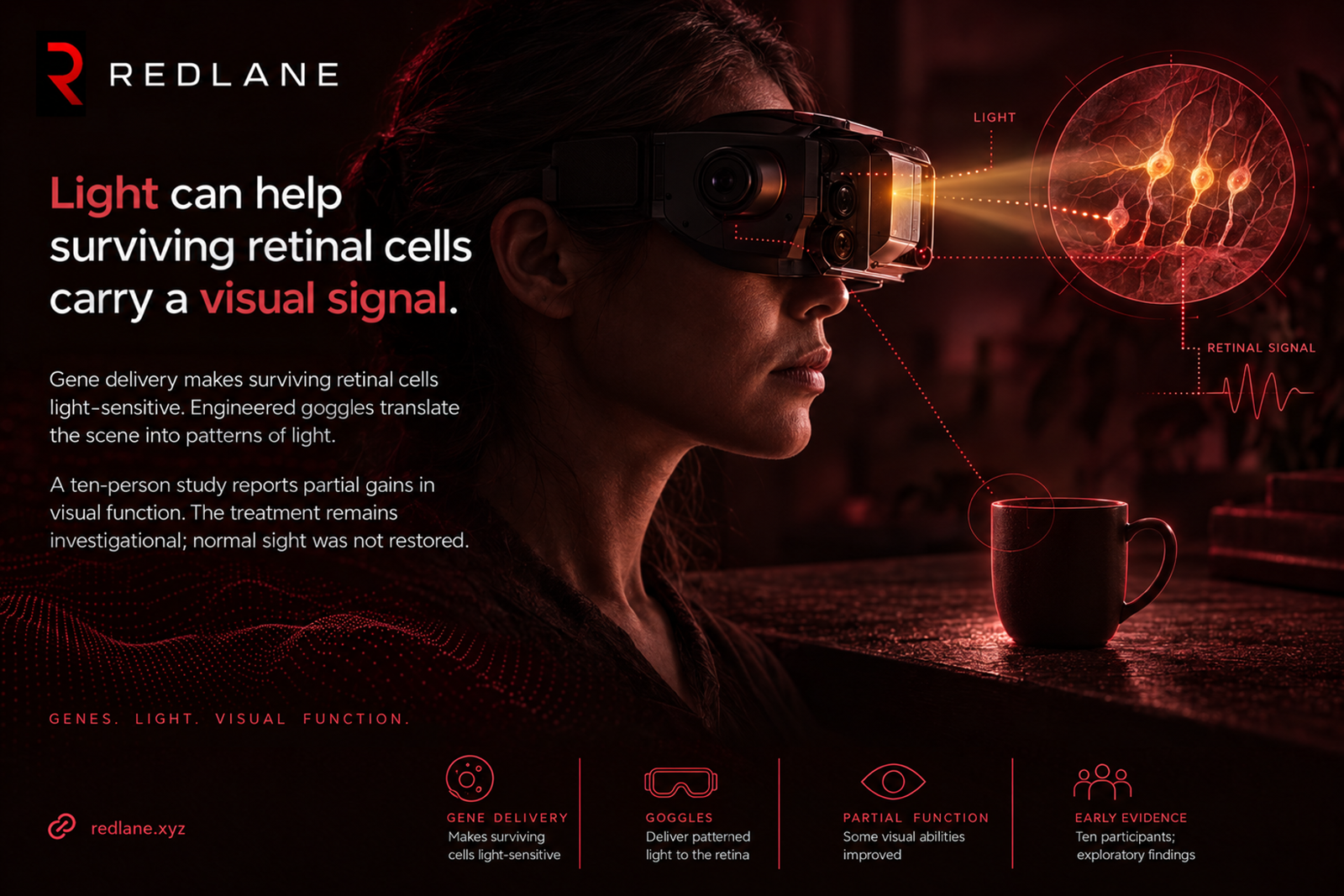
This week also brought a new clinical result: an international team led by José-Alain Sahel and Botond Roska reported aspects of visual recovery in a ten-person study of advanced retinitis pigmentosa. The work, published in the New England Journal of Medicine, combines gene delivery with light-stimulating goggles. It brings a practical question into focus: can a tool developed to investigate neural circuits become a usable sensory interface? [Clinical publication announcement]
What the Nobel recognizes
Optogenetics combines genetic targeting with optical stimulation. Researchers arrange for particular cells to produce light-sensitive proteins called opsins. Light can then alter electrical activity in those cells. The approach depends on preparing the cells and delivering the right stimulus; shining a light at an untreated brain or eye does not create the same effect. [Stanford explanation]
Its scientific value lies in intervention. Recording activity can show that a neural circuit is associated with a behaviour. Selectively changing that circuit and observing the consequences provides a way to test its causal role. The Nobel honours the discoveries behind this research method. It does not certify the effectiveness of every subsequent therapy that uses it. [Official award]
From one patient to a clinical cohort
In 2021, the same clinical research programme reported a single blind patient who could perceive, locate and touch objects with the treated eye while wearing engineered goggles. Those abilities were absent before treatment and were not observed after treatment without the goggles. That was a proof of concept for a combined biological and optical system. [2021 original paper]
The new report expands the evidence to ten participants. IOB reports clinically meaningful increases in light sensitivity in six, with some participants improving at tasks such as locating objects or finding doorways while using the goggles. These are distinct measures: detecting more light and using a visual signal to complete a task are related, but they are not interchangeable. [Reported cohort findings]
The PIONEER Phase 1/2 programme primarily assessed safety. The joint hospital and sponsor announcement describes the visual findings as exploratory and explicitly states that the study was not designed to establish efficacy. The strongest reading is an early clinical signal that warrants further testing. [Hospital and sponsor announcement]
Why the goggles matter
Retinitis pigmentosa can destroy the photoreceptors that normally begin the visual process. This approach makes surviving retinal ganglion cells light-sensitive instead. In the earlier study, a viral vector delivered the gene for ChrimsonR, and the goggles translated changes in the scene into light pulses projected onto the retina. The system works around a damaged stage of the visual pathway. [Original mechanism]
For readers following gene therapy, the useful distinction is between changing a cell and producing a usable function. The optical device helps determine the signal the modified cells receive. A complete assessment also has to ask how much training people need, whether that training is practical and whether gains persist when the system is used in daily life.
What the study does not prove
The treatment did not restore normal sight. A small early-stage cohort cannot establish how reliably the approach will work across a larger population, which people will benefit most, or whether task improvements translate into sustained independence in daily life. [Limits of the reported recovery]
Safety findings also need precise language. The public reports describe ocular adverse events, including temporary inflammation and eye-pressure increases. Encouraging tolerability in this cohort does not mean an absence of risk. [Reported safety findings]
The sponsor reports that GS030 remains investigational and has no marketing authorization. [Regulatory context]
Light-sensitivity gains should not be turned into a cure rate. The clinical question is whether a person can use the new signal consistently, safely and meaningfully outside a test session. Nor does this retinal study demonstrate a treatment for memory disorders or establish that optogenetic techniques used in animal brains are ready for routine human care.
What to watch next
Our interpretation is that the next decisive results should connect measurable visual changes with useful everyday tasks. Larger studies, stronger comparisons, longer follow-up and clearer reporting of training requirements would make the clinical value easier to assess. Device comfort and dependable performance deserve attention alongside the biological intervention.
There is also a broader engineering lesson. The performance of this system has to be judged across its components: gene delivery, surviving cells, optical hardware, training and outcome measurement. An impressive result in one component cannot stand in for evidence that the entire system works well for patients.
Why REDLANE is watching
This follows the same practical question as our Signals on prime editing and surgical AI: what has to work together before a research advance becomes useful? Optogenetics adds a particularly clear case in which biology, sensing and interpretation meet. For REDLANE, the lesson is about reading evidence with its conditions attached. The Nobel marks an established scientific contribution; the new clinical report marks an exploratory application. Keeping those two milestones distinct makes both easier to understand.
Editorial & rights note. Original REDLANE analysis based on the linked research and primary institutional reports. The clinical findings were checked against the research team’s public summaries; the complete NEJM methods were not available for direct review. No paper text, figures or photographs are reproduced.