
The planning problem
A tugboat goes out of service. A berth closes. The schedule that worked yesterday may no longer fit. Researchers at Nanyang Technological University in Singapore (NTU) use these changing port conditions to explain the challenge behind LACE: helping people develop algorithms for planning problems as their requirements change.
These problems belong to combinatorial optimization, the search for a good arrangement among many possibilities. Google’s OR-Tools documentation gives familiar examples: delivery routes with capacity limits, tasks that must happen in a particular order and objects that must fit into containers. Algorithms narrow the search so computers can find useful solutions within practical time limits.
The signal
Published on 1 October in Nature Machine Intelligence, the LACE study reports an average score of 0.945 across 36 classical CO-Bench problems. The strongest compared language-model-based method scored 0.870, while direct prompting without a framework scored 0.571. On four new port-related problems, LACE reached 0.97–0.99 while five compared language-model methods produced no feasible algorithm. The four new tasks have no published optimum for comparison.
The benchmark compares solution quality with reference results, with higher scores indicating closer matches.
Those are benchmark scores under the researchers’ evaluation. They do not measure fuel savings, lower shipping costs or performance in a working port.
Several strategies, tested together
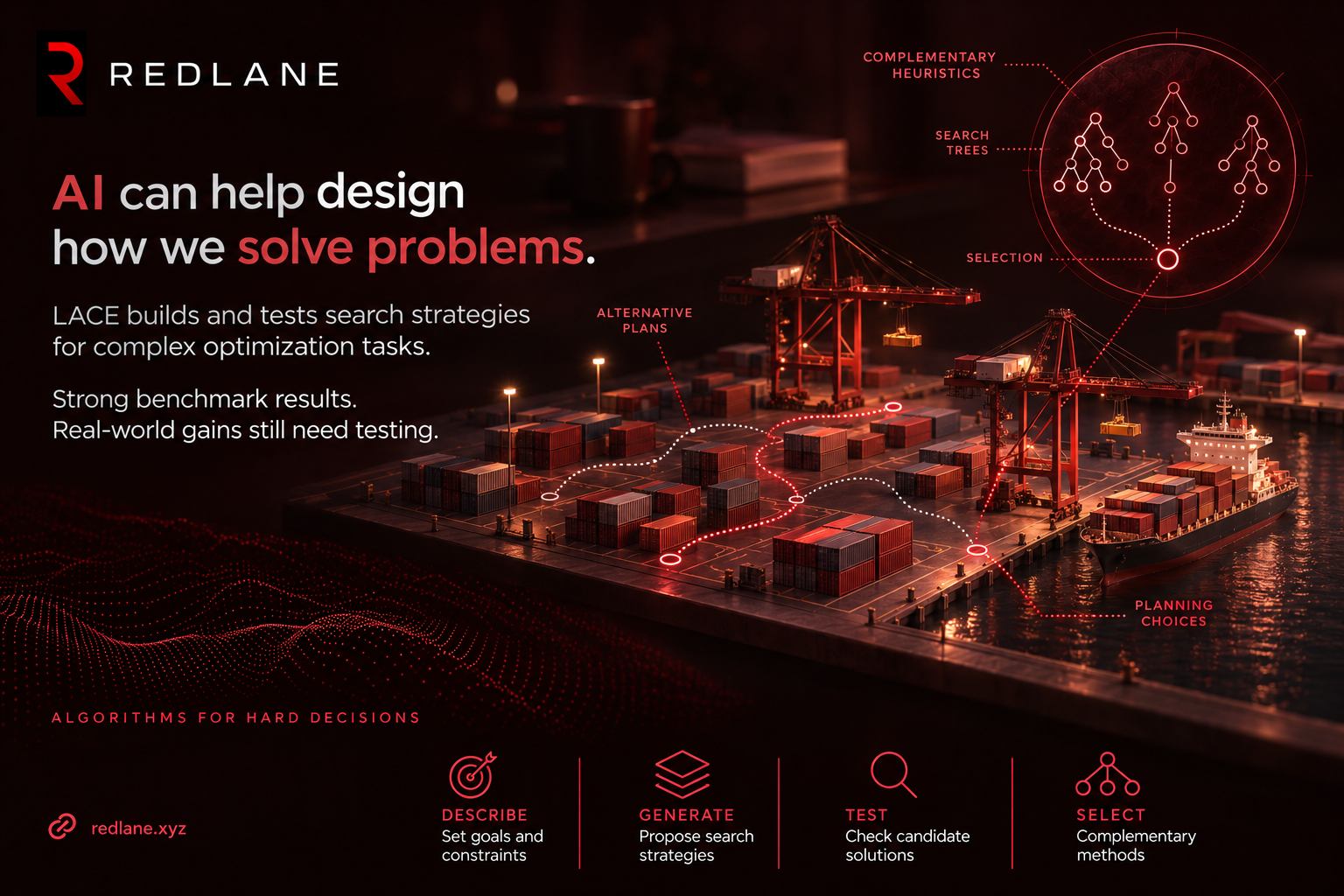
LACE develops heuristics: methods for finding useful solutions without exhaustively checking every possibility. NTU describes a structured process that establishes the information an algorithm receives and the form a valid result must take. The system then generates candidate strategies, tests and modifies them, and selects a portfolio whose members complement each other across different cases.
The authors’ public implementation exposes the supporting tools, including checks for feasibility and a way to score results. It also releases problem instances and the evolved algorithms. That gives other researchers material to inspect and test, rather than only a headline result.
What still needs checking
A checker can run successfully and still encode the wrong rule. The authors’ reproduction guide explicitly distinguishes a usable, self-consistent problem contract from semantic correctness: for a new problem, the meaning of its constraints ultimately depends on the description and human review.
There is also a difference between finding a feasible plan and proving it is the best possible plan. Google’s routing documentation explains why large routing problems can require practical compromises, even with established optimization software.
REDLANE perspective
We see the opportunity in shortening the distance between describing an operational problem and testing several ways to solve it. Domain knowledge still decides which rules matter, what the objective should reward and which trade-offs people can accept. A planner should be able to see why a candidate failed and decide whether the model misunderstood the task or the task itself needs revision.
The next evidence we would look for is operational: performance when conditions change, when inputs arrive late, or when a plan must work alongside an existing system. Comparisons should measure results under the same constraints and computing budget. A strong research score becomes more useful when that connection to daily work is visible.